
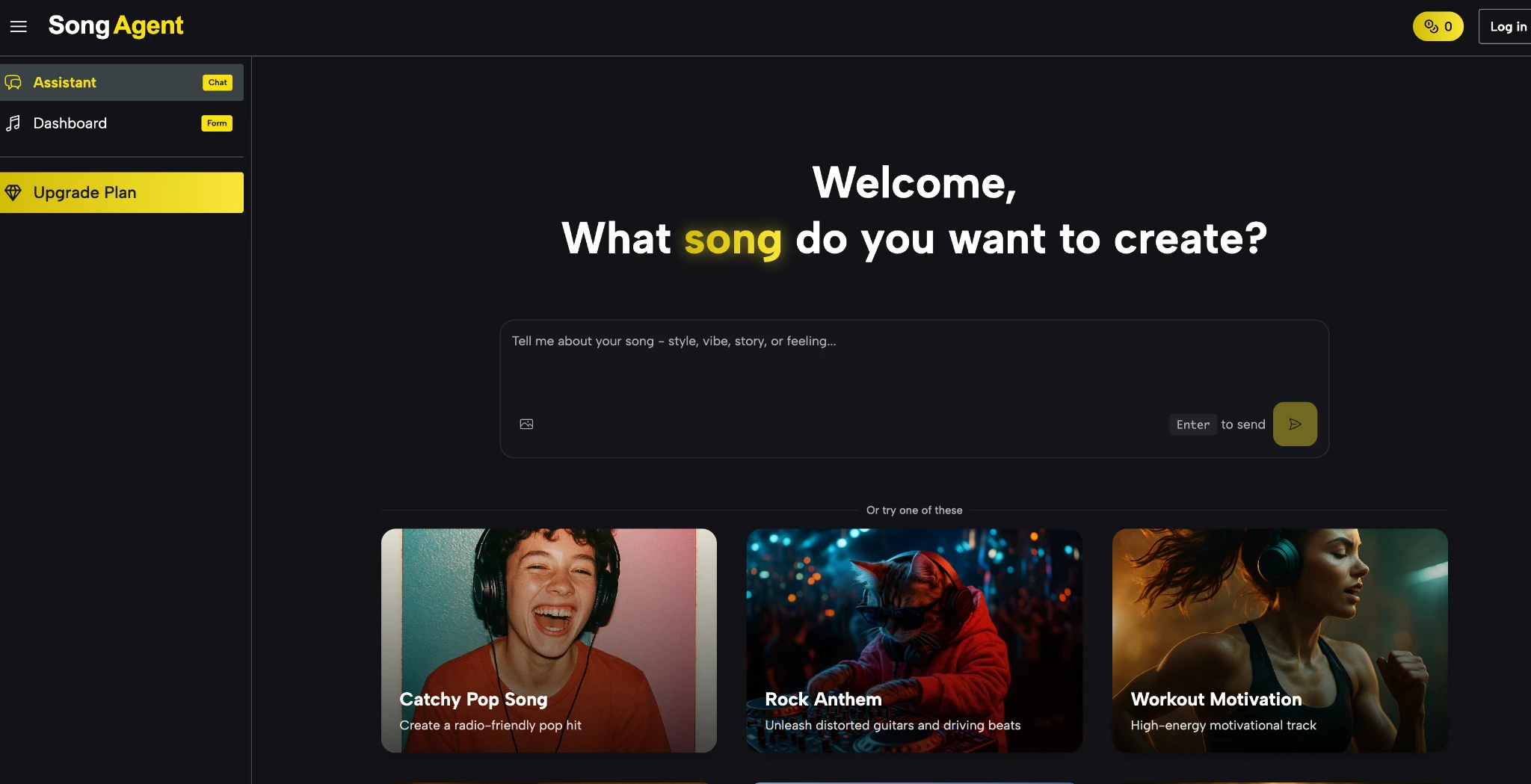
AI music has reached the point where almost every product can promise a track from a prompt. That makes the label matter less than the workflow behind it, especially when a creator is deciding whether an ai song agent is a real production partner or just a generator with a sharper name.
The useful question is not whether the software can make sound. It is whether it can help a director, producer, editor, or technically curious creator move from intent to usable assets without restarting the creative process every time a prompt misses the mark. That is where SongAgent is interesting: its public positioning is built around conversation, planning, refinement, batch creation, and handoff, not only one-shot audio creation.
Why The Word Agent Needs A Stricter Test
An agent, in a creative workflow sense, should do more than accept a text description and return a finished file. It should preserve intent across steps, expose some form of plan before output, and support the kind of iteration that happens when music is being shaped for a video series, podcast package, game scene, or campaign.
That does not mean the tool must be autonomous in a technical architecture sense. For this article, agent is an editorial standard: does the product behave like workflow support, or does it mainly behave like a prompt box attached to an audio model?
Criterion One: Plans Before The First Output
The first test is whether the system treats the prompt as raw direction or as a brief to be interpreted. SongAgent emphasizes a musical blueprint before generation, including structure, instrumentation, key signature, tempo, and style elements. That matters because many creative failures are not audio failures; they are planning failures.
Blueprints Turn Vague Direction Into Shared Intent
For a producer, a blueprint creates a checkpoint. If the brief says ambient electronic music for a product demo, the creator can think about whether the tempo, emotional tone, and instrumentation are aligned before committing to a full generation. From a practical user perspective, that makes SongAgent feel closer to a collaborator that drafts a plan than a slot machine that only reveals its logic afterward.
Suno and Udio also support prompt-driven music creation, and both are credible options in the broader category. Their visible category strength is directness: describe a song, create, then extend, regenerate, edit, or remix depending on the platform. The agent distinction is narrower: does the workflow foreground the plan as a creative artifact, or is the plan mostly implied inside the generation?
Criterion Two: Refinement Without Starting Over
The second test is iteration. Real creative direction rarely arrives as one perfect prompt. A chorus needs more lift, a bridge needs a different texture, a vocal idea needs separation, or a mood bed needs to become less intrusive under narration.
SongAgent says users can continue the conversation after generation and request changes such as making a chorus more energetic or adding strings in a bridge. That conversational revision path is central to agent-style positioning because it keeps the creator in a continuing loop with the same musical intent. A plain generator can still be useful, but if every adjustment feels like a fresh throw, it is harder to call the workflow agentic.
Where Batch Creation Changes The Category
Batch work is where the agent test becomes more practical. A single impressive song is useful, but many professional needs are systems of related tracks: a podcast intro and outro, a set of ad variants, a meditation series, an educational song collection, or level-specific game themes.
SongAgent explicitly positions batch creation for albums, podcast music packages, video game soundtracks, commercial jingles, meditation tracks, and educational song series. That is a meaningful category signal because the value is not just the ability to make more audio. It is the ability to keep related outputs within a coherent creative direction.
Criterion Three: Coherent Series Over Isolated Tracks
A creative director does not usually need one random cue. They need a family of cues that can live in the same brand world. If a tool can carry genre, instrumentation, mood, and intended use across multiple pieces, it becomes more relevant to campaign and content systems.
This is where a middle-ground definition of an ai music agent is useful. It should not be treated as a fully independent composer, but it should reduce the friction of turning one creative brief into several related assets. SongAgent’s emphasis on albums, song series, and packaged use cases gives it a stronger claim here than products that lead mainly with single-track generation.
Handoff Is Where Music Becomes Production
The fourth test is what happens after the track exists. A finished audio preview may be enough for a quick social clip, but production teams often need formats and parts they can carry into editing, mixing, and review.
SongAgent’s paid plan feature set lists MP3 download, WAV download, vocal separation, and up to 10 stems. Those details matter because they connect the generative step to the production step. A WAV file is more useful in an edit timeline than a low-quality preview, and stems or separated vocals can give a producer more room to revise without generating a completely new track.
Criterion Four: Assets That Survive The Edit
Suno also presents a strong handoff story, including time-aligned WAV stems and visible positioning for creators and producers. SOUNDRAW is more licensing and background-music oriented, with plans that emphasize royalty-free use cases, downloads, and, on some tiers, WAV and stems. Udio has a more complicated current story because its help materials describe credits for create, extend, remix, inpaint, and edit actions, while also noting that audio, video, and stem downloads have been disabled as part of UMG partnership changes.
The fair distinction is not that one tool owns post-production. It is that an agent-style product should make handoff part of the core promise, not an afterthought. SongAgent does that by pairing conversation and refinement with formats, vocal separation, and stems.
How Leading Options Compare On Workflow Depth
| Product | Agent-like workflow | Prompt-to-song simplicity | Refinement depth | Batch depth | Export/DAW handoff |
|---|---|---|---|---|---|
| SongAgent | Strong public emphasis on blueprint, conversation, refinement, and production handoff | Supports natural-language song direction | Continued conversational requests are part of its positioning | Explicit use cases for albums, soundtracks, jingles, and song series | MP3, WAV, vocal separation, and up to 10 stems listed on plans |
| Suno | Broad creator workflow, with strong mainstream generation positioning | Very direct prompt-to-song flow | Regenerate, extend, refine, and studio-oriented features are visible | Useful for repeated creation, less explicitly framed around packaged series | WAV stems and producer-facing tools are part of its visible offer |
| Udio | Strong editing vocabulary through create, extend, remix, inpaint, and edit | Fast music creation from prompts | Credit-based editing actions are documented | Credit structure supports repeated work within limits | Downloads are currently constrained in its help materials |
| SOUNDRAW | Less agent-like, more library-style generation and licensing workflow | Built for quick royalty-free background music | Focuses less on conversational song development | Practical for many content pieces, especially background tracks | MP3, and WAV/stems on higher music-focused plans |
Honest Limitations In Agent Framing
The main limitation is that agent is a workflow label here, not proof of technical autonomy. SongAgent describes a blueprint, conversational refinement, batch creation, downloads, vocal separation, and stems, but public research does not verify the logged-in interface, generation quality, prompt accuracy, speed, stem quality, or legal enforceability of commercial-rights language. Results may also depend heavily on how clearly the creator describes genre, structure, use case, and revision requests.
That limitation does not weaken the category argument. It simply keeps the claim grounded: SongAgent appears credible as an agent-style music workflow because of the steps and assets it foregrounds, not because anyone should assume it replaces direction, taste, legal review, or production judgment.
Who Should Reach For Agent-Style Creation
The strongest fit is a creator who thinks in packages rather than isolated tracks. A YouTube editor may need recurring intro beds and transition cues. A podcast producer may need a consistent sonic identity across segments. A game designer may need mood variations for levels, menus, and scenes. A brand team may need quick jingle concepts before a campaign direction is locked.
For those users, SongAgent offers a clearer category story than a simple prompt-to-audio promise. Its strength is the way it frames the work: describe the musical intent, review a plan, refine through conversation, create related pieces, and hand off usable assets. That is the threshold a modern AI song agent should be judged against.
