
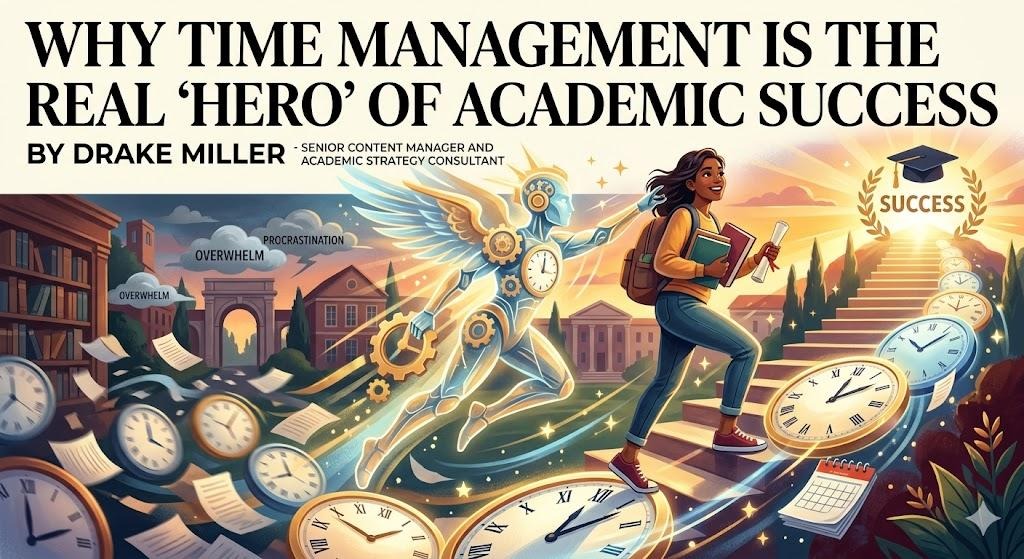
By Drake Miller – senior content manager and academic strategy consultant
The life of a student in Australia—whether navigating the VCE in Melbourne, tackling the HSC in Sydney, or pursuing a degree at a top-tier university like ANU, UQ, or the University of Melbourne—is often described as a “balancing act.” Between lectures, part-time jobs, social commitments, and the relentless cycle of assessments, the pressure can feel overwhelming.
When we talk about academic excellence, we often credit intelligence, expensive tutors, or “natural talent.” However, as a content manager and academic consultant who has watched thousands of students navigate these waters, I can tell you that the true “hero” working behind the scenes is often overlooked: Time Management. It isn’t just about using a planner or waking up early. It is the fundamental framework that separates students who survive from those who thrive. In the competitive landscape of 2026, where digital distractions are at an all-time high, mastering your clock is your greatest competitive advantage. Many students now find that balancing these demands is easier when they supplement their study schedules with professional online assignment services .
1. The Myth of the “All-Nighter”
In Australian high schools and universities, there is a strange culture of glorifying the “all-nighter.” Students brag about staying up until 4:00 AM fueled by energy drinks to finish a 2,000-word essay.
But science tells a different story. Sleep deprivation impairs cognitive function, memory retention, and critical thinking—the very tools you need to excel. Effective time management kills the need for “panic-mode” studying. By breaking down a large project into manageable chunks over two weeks instead of two nights, you ensure your brain is rested and your work is of a higher caliber.
Furthermore, many Australian institutions, such as Monash or UNSW, have recently updated their Special Consideration and wellbeing policies. They emphasize that “crunch culture” is a leading cause of burnout and long-term academic fatigue. By managing your time, you align yourself with a healthier, more sustainable version of high performance that universities now actively encourage and reward.
2. Reducing the “Cognitive Load”
Academic stress rarely comes from the work itself; it comes from the thought of the work. When you have five pending assignments and no plan, your brain experiences “cognitive overload.” You spend more time worrying about what to do next than actually doing it.
Time management acts as a mental offload. When you schedule your tasks, your brain can focus entirely on the present moment. If it’s 4:00 PM and your calendar says “Research for History Essay,” you don’t have to worry about your Chemistry lab report because you know that it is scheduled for tomorrow. For those studying in Queensland, local support such as assignment services Brisbane can provide the specific regional expertise needed to lighten this load during peak exam seasons. This focus leads to “Deep Work,” a state of peak productivity where the best academic breakthroughs happen. In an era of constant smartphone notifications, the ability to engage in 90 minutes of uninterrupted study is a “superpower” for any Australian student.
3. Beating Procrastination: The Silent GPA Killer
Procrastination is often a defense mechanism against a task that feels too big. We see a 3,000-word dissertation and instinctively reach for our phones to scroll through TikTok or Instagram.
Time management techniques, such as the Pomodoro Technique (25 minutes of work followed by a 5-minute break), make the “unfinishable” feel “doable.” By managing your time, you aren’t fighting your procrastination with willpower; you are bypassing it with a system. For students tackling heavy units like Advanced Mathematics or Physics, breaking sessions into these high-intensity intervals prevents the mental fatigue that leads to “doom-scrolling.”
The Australian Context: Why it Matters for You
For students in Australia, time management is particularly crucial due to the unique structure of our education system in 2026.
- Continuous Assessment: Unlike systems that rely solely on a final exam, Australian institutions often use a weighted system of assignments, presentations, and mid-terms. This “steady-drip” of assessments means that if you lose track of time in Week 4, your Week 12 grades and final ATAR will suffer.
- The Work-Study Balance: A high percentage of Australian students work part-time in retail or hospitality. In 2026, with the rising cost of living, this balance is more precarious than ever. Without a strict schedule, your job can easily bleed into your study time, leading to exhaustion.
- Vocational and Academic Split: With the rise of the VCE Vocational Major (VM) and the integration of micro-credentials, many students are now balancing workplace learning with classroom theory. This dual responsibility requires a level of organizational sophistication previously only seen in corporate environments.
- External Support: Sometimes, despite the best planning, the workload becomes mathematically impossible. In these instances, ensuring academic integrity and structured assignment guidance is vital. Professional resources like MyAssignmentHelp can provide the necessary mentorship and support to help you stay on track without compromising your mental health or your grades.
4. Quality Over Quantity: The “Spaced Repetition” Factor
There is a common misconception that the student who spends 10 hours in the library is “better” than the one who spends 3. In reality, the 3-hour student likely has superior time management.
Effective time management emphasizes Active Recall and Spaced Repetition. Instead of “marathon” study sessions where your brain checks out after hour two, managed sessions allow for high-intensity learning. This leaves more time for the things that keep you human—surfing at Bondi, hiking in the Dandenongs, or simply spending time with friends. Learning how to study “shorter but harder” is the hallmark of the elite Australian student.
5. Building “Life Skills” Beyond the Classroom
University and High School are essentially “simulators” for the real world. Employers in Australia—whether in law firms in Sydney’s CBD or engineering firms in Perth—don’t just look at your GPA. They look for “Soft Skills.”
Time management is the most sought-after soft skill in the professional world. If you can demonstrate that you managed a full-time study load, a part-time job, and a volunteer position, you are telling an employer that you are disciplined, reliable, and capable of handling high-pressure environments. You aren’t just earning a degree; you are building a professional reputation.
6. Managing Digital Distractions in 2026
We live in an era where AI and algorithms are designed to capture our attention. For a student, this is the ultimate hurdle. Time management in 2026 isn’t just about a paper planner; it’s about Digital Hygiene.
Successful students are now using “Focus Modes” on their devices and leveraging Agentic AI to help organize their research, rather than letting the technology dictate their day. By setting specific “tech-free” windows, you allow your brain to enter the theta waves required for complex problem solving—something you’ll never achieve if you’re checking your phone every six minutes.
Actionable Strategies for Students
If you’re ready to let time management be your hero, start with these four proven steps:
A. The “Big Rocks” Method Prioritize your tasks. Imagine a jar. If you fill it with sand (small, unimportant tasks) first, the big rocks (major assignments) won’t fit. Put the big rocks—those heavy-weighted HSC or VCE assessments—in your calendar first, then fill the gaps with the “sand” of minor readings or admin.
B. Audit Your Digital Time For one week, use your phone’s “Screen Time” feature to track your habits. You might be surprised to find you spend 15 hours a week on social media. That’s two full workdays! Repurposing just half of that time into a “Deep Work” block can transform your grades from credits to high distinctions.
C. Use Technology, Don’t Let it Use You Use apps like Notion, Trello, or Google Calendar to map out your semester. Sync your deadlines the moment you receive your course outline or Unit Guide. Use these tools to create a skeleton of your week, but ensure you leave “buffer zones” for unexpected life events.
D. The “Two-Minute Rule” If a task takes less than two minutes (like replying to a tutor’s email or downloading a lecture slide), do it immediately. This prevents small tasks from piling up into a mountain of “administrative debt” that creates unnecessary anxiety.
Frequently Asked Questions
Q.1 Why is time management more important for Australian students in 2026?
With the introduction of the VCE Vocational Major and the expansion of the Lifelong Learning Entitlement, students are balancing more diverse credit loads than ever before. Effective scheduling ensures you can manage hybrid learning environments without succumbing to burnout.
Q.2 How does the Pomodoro Technique help with heavy HSC/VCE workloads?
The Pomodoro Technique breaks cognitive tasks into 25-minute sprints. This is particularly effective for high-stakes Australian assessments because it prevents “mental fading,” ensuring that the quality of your work at the end of a session is as high as at the beginning.
Q.3 Can time management actually improve my ATAR?
Yes. A higher ATAR isn’t just about being “smart”; it’s about consistency. Students who manage their time effectively avoid the “ranking dip” that occurs when multiple mid-term assessments collide in Week 7 or 8.
Q.4 What is the best way to balance a part-time job and university in Sydney or Melbourne?
The “Fixed-Schedule Productivity” method works best. Treat your study hours like a shift at work. If you are “on the clock” for your essay from 10:00 AM to 1:00 PM, you are less likely to let work-related stress interfere with your academic progress.
Q.5 Does the Australian education system favor students with better time management?
Because the Australian system relies heavily on weighted continuous assessment rather than a single end-of-year exam, students who can maintain a steady output over 12 weeks consistently outperform those who rely on “cramming.”
Conclusion
Academic success isn’t a result of luck or purely innate brilliance. It is the result of a series of small, disciplined choices made every day. Time management gives you the freedom to enjoy your youth and the vibrant Australian lifestyle while ensuring you reach your professional goals.
Don’t let your assignments manage you. Take control of your clock, utilize the expert resources available to you, and watch how the “hero” of time management transforms your academic journey. For more academic tips and professional writing assistance, visit MyAssignmentHelp to ensure your hard work always meets the highest standards of excellence.
About the Author
Drake Miller is a senior content manager and academic strategy consultant with over a decade of experience in the higher education sector. Based in London and Sydney, Drake specializes in helping students navigate the complexities of modern education through the lens of productivity and digital wellness.
